
How to Choose an OSHA Compliant Cleaning Company
- Tony Duarte

- Jul 14
- 6 min read
A cleaning crew can make a property look finished while still creating avoidable risk. On an active construction site, in a warehouse with moving equipment, or inside a manufacturing facility, cleaning work affects access, air quality, slip hazards, and the safety of every trade on site. Choosing an OSHA compliant cleaning company means selecting a partner that can work within those conditions with discipline, not simply a vendor that arrives with mops and vacuums.
For general contractors, facility managers, developers, and logistics operators, the right choice protects schedules as much as it protects people. Cleaning must happen around equipment, staged materials, elevated work areas, tenant turnover requirements, and daily operations. The provider should understand the scope, identify hazards before work starts, and execute without becoming another coordination issue for your team.
OSHA Compliance Is More Than a Certificate
OSHA does not issue one universal certification that makes a company permanently "OSHA compliant." Compliance is an ongoing operational responsibility. It depends on the work being performed, the site conditions, the equipment in use, and whether the contractor follows applicable safety requirements every day.
That distinction matters during vendor selection. A cleaning company may advertise trained workers, but decision-makers should look beyond a broad claim. Ask how the company manages hazard communication, personal protective equipment, fall exposure, chemical handling, powered equipment, and site-specific procedures. A serious commercial cleaning provider should be able to explain its process clearly.
For post-construction cleaning, risk changes by phase. A rough clean may involve debris removal, dust control, and clearing work paths while other trades remain active. A final clean may require detailed work around finished surfaces, glass, fixtures, and punch-list items. The safety plan should match the phase rather than relying on a one-size-fits-all checklist.
What an OSHA Compliant Cleaning Company Should Provide
An OSHA compliant cleaning company should begin with a defined scope and a site review. Large commercial facilities are not cleaned effectively from a generic price sheet. Square footage is only one factor. The crew also needs to understand ceiling height, floor condition, access limitations, occupancy status, construction activity, debris volume, shift schedules, and whether work must be completed outside operating hours.
A site-specific assessment helps prevent common problems: crews arriving without the right equipment, cleaning chemicals being used in sensitive areas, high-reach dust being missed, or work being scheduled where it interferes with material movement and trade sequencing. It also gives the provider a basis for staffing the project appropriately.
Safety Training That Matches the Work
Training should be relevant to the actual environment. A technician cleaning an office suite faces different hazards than a crew member working in a distribution center or on a jobsite with ongoing construction activity. Ask whether personnel receive safety instruction on the conditions they are likely to encounter, including hazard recognition, proper PPE use, safe lifting, chemical labeling, emergency procedures, and reporting protocols.
Where elevated work is required, verify that the crew is qualified to use the equipment involved. High-reach dust mitigation, overhead detailing, and cleaning around racking or structural elements can require aerial lifts or other access equipment. Aerial Lift-certified crews bring a higher level of preparedness to these tasks, but certification alone is not enough. The work area must still be assessed for traffic, clearance, overhead obstructions, floor loading, and site-specific restrictions.
Chemical Management and Hazard Communication
Commercial cleaning requires more than selecting a product that removes soil. Chemicals must be stored, labeled, transported, and used according to their instructions and the conditions of the facility. This is especially relevant in manufacturing, food-adjacent operations, healthcare-adjacent environments, and occupied multi-tenant properties.
A capable provider maintains safety data sheets, trains personnel on hazard communication, and uses products suited to the surface and task. The goal is not to use the strongest chemical available. The goal is to achieve the required result without damaging finishes, introducing unnecessary exposure, or creating incompatible chemical combinations.
Equipment, PPE, and Access Controls
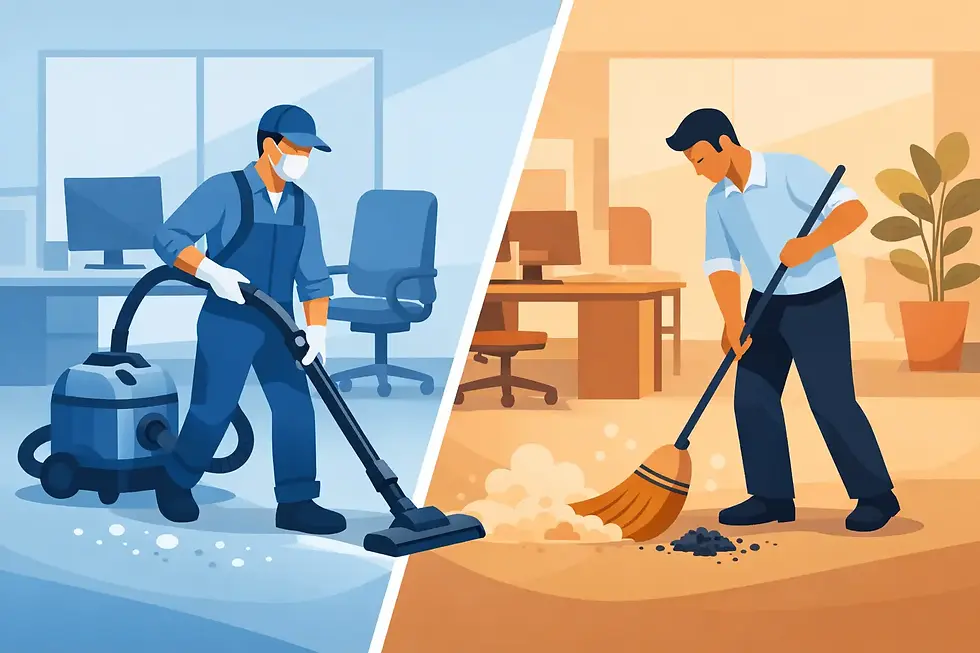
Cleaning crews should arrive with commercial-grade equipment appropriate for the scope. Depending on the facility, that may include HEPA-filtered vacuums for fine dust, auto scrubbers for large floor areas, burnishers, pressure washing equipment, high-reach tools, and debris-removal systems. Equipment selection affects both cleaning quality and jobsite safety.
PPE should be determined by the task and documented site requirements. Gloves and eye protection may be standard for chemical work, while high-visibility apparel, hard hats, safety footwear, respiratory protection, hearing protection, or fall-protection measures may be necessary in other settings. A provider should not treat PPE as a visual formality. Crews need the right protection and the training to use it correctly.
Access control is equally important. Wet-floor signage, cord management, barricaded work zones, clear walkways, and coordination around forklift traffic reduce the chance that cleaning disrupts an active facility. In a warehouse, a spotless floor does not help if the work creates a conflict with loading operations.
Questions to Ask Before You Award the Contract
The best time to evaluate safety practices is before the crew is on site. During a walkthrough or proposal review, ask practical questions that reveal how the company plans work.
Ask who supervises the crew, how the company communicates changes in site conditions, and whether it can scale labor for schedule-driven turnover dates. Confirm the company carries appropriate insurance and can provide documentation required by your project or facility. For recurring services, ask how quality checks are handled after the initial launch and how service issues are escalated.
You should also ask how the provider separates construction cleaning from standard janitorial work. The difference is significant. Construction dust can settle repeatedly, debris can create puncture and trip hazards, and completed surfaces may require careful protection. A generic janitorial approach can leave critical details unfinished or damage materials during the final phase.
For industrial and logistics facilities, ask how the company works around operations. Will floor cleaning be scheduled around shifts? Can crews clean safely near racking, docks, machinery, and staging areas? Does the provider have a plan for high-traffic aisles and large-footprint spaces? The right answer is rarely identical for every site.
Match the Scope to the Facility’s Risk Level
Not every building requires the same level of cleaning support. A newly completed office suite may need a detail clean and final punch cleaning before occupancy. A distribution center may need recurring machine floor cleaning, dust management, restroom service, and breakroom upkeep without interrupting outbound schedules. A manufacturing operation may require more frequent attention to debris, surface buildup, and safety-sensitive work zones.
This is where tailored planning matters. An overly lean scope can leave dust, floor hazards, and presentation issues for internal staff to address. An overly broad scope can create unnecessary cost and overlap with other contractors. A qualified provider should help define the frequency, staffing, equipment, and cleaning phases that fit the facility rather than pushing a standard package.
CC Smart Maintenance approaches commercial cleaning as an operational function. From rough clean through final turnover, or from periodic industrial floor care through daily janitorial maintenance, the work must support a safer, more orderly environment and keep the property ready for its next inspection, shift, tenant, or customer visit.
Watch for Gaps That Create Risk
Low pricing can be attractive, particularly when a project is approaching closeout. But a quote that does not account for access, debris volume, ceiling height, required equipment, or after-hours work often creates problems later. The result may be change orders, missed areas, rushed labor, or a crew working without the preparation the site requires.
Be cautious when a vendor cannot describe its safety process in plain terms, provides vague staffing commitments, or treats construction and industrial cleaning as interchangeable with routine office service. These are specialized environments. They require coordination, trained labor, dependable supervision, and a clear understanding of what "clean" means at each stage.
The right cleaning partner should make your operation easier to manage. When a crew arrives prepared, follows site requirements, communicates clearly, and finishes to the agreed standard, your team can focus on turnover, production, leasing, and daily operations instead of chasing cleanup issues.
A clean facility should never be separated from a safe one. Build compliance expectations into the scope from the start, verify that your provider can meet them, and give the cleaning crew the information it needs to perform correctly. That preparation is what turns cleaning from a last-minute task into a reliable part of site readiness.


Comments