
Post Construction Cleaning vs Janitorial Services
- Tony Duarte

- Jul 27
- 6 min read
A newly completed commercial space can look finished while still carrying construction dust in overhead areas, adhesive residue on glass, debris in corners, and fine particulate across floors and fixtures. That is why post construction cleaning vs janitorial is not simply a choice between two versions of the same service. For contractors, developers, facility operators, and property managers, the right service depends on the condition of the site, the project phase, and the standard the space must meet before turnover or daily use.
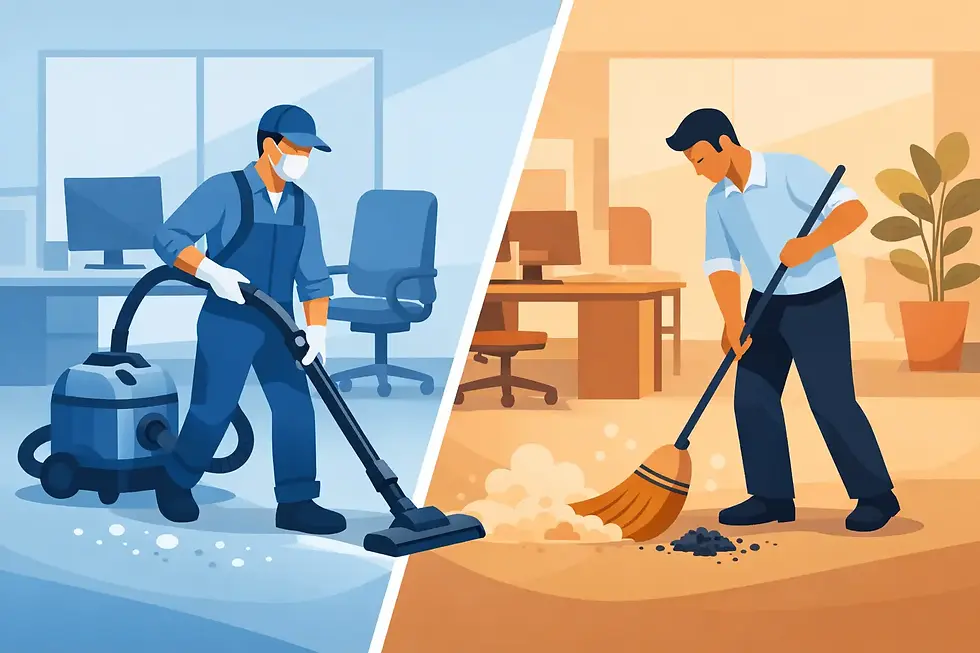
Post-construction cleaning prepares a site for inspection, occupancy, or handoff after building work. Janitorial service maintains a clean, safe, presentable environment after the property is operational. Both are necessary in commercial real estate and industrial environments, but they solve different problems and require different crews, equipment, schedules, and safety planning.
Post Construction Cleaning vs Janitorial: The Core Difference
Post-construction cleaning is a project-based service designed for an active or recently completed construction site. Its purpose is to remove the evidence and residual hazards of construction work so the finished space is ready for the next phase. The work may occur in stages, from an initial rough clean through detailed cleaning and final punch cleaning.
Janitorial cleaning is recurring maintenance. It is built around preserving a facility's daily condition once employees, tenants, visitors, inventory, or production activity are already in place. A janitorial program may run nightly, several times per week, or on a customized schedule based on occupancy, traffic, and operational requirements.
The distinction matters because a crew equipped for routine office cleaning may not be prepared to remove drywall dust from high ledges, manage construction debris, detail newly installed fixtures, or operate safely around lifts, unfinished surfaces, and active trades. Likewise, a post-construction crew is not automatically the best fit for a daily restroom, breakroom, and common-area maintenance schedule. The scope should match the environment.
What Post-Construction Cleaning Covers
Construction cleanup is typically more labor-intensive and variable than recurring janitorial work. Scope changes based on building type, project size, remaining trade activity, access conditions, and the level of finish required by the owner or general contractor.
A rough clean usually follows major construction activity. Crews remove loose debris, packaging, scrap material, and bulk dust so trades can continue working safely and efficiently. This phase is not about presentation. It is about making the site more manageable and reducing accumulated material that can interfere with final work.
The detailed clean occurs closer to project completion. It addresses settled dust, interior glass, baseboards, fixtures, cabinetry, doors, flooring, restrooms, and other finished surfaces. Fine construction dust travels well beyond the area where it was created, particularly in large warehouses, manufacturing facilities, multi-tenant buildings, and high-ceiling spaces. A proper detailed clean accounts for horizontal, vertical, and high-reach surfaces rather than focusing only on what is visible at eye level.
Final punch cleaning supports closeout and turnover. The goal is a polished, move-in-ready result that helps the project team present the space with confidence. Depending on the scope, this can include spot-cleaning after punch-list corrections, removing stickers and protective films, cleaning windows and glass partitions, and preparing common areas for owner walkthroughs.
Safety is central to this work. Construction environments can involve uneven floors, exposed equipment, limited lighting, elevated work, and coordination with multiple trades. For high-reach dust mitigation or elevated surfaces, trained crews and appropriate lift practices are essential. OSHA-certified and Aerial Lift-certified technicians bring a level of site readiness that general cleaning labor may not provide.
What Recurring Janitorial Service Covers
Janitorial service begins when a property needs consistent upkeep, not construction recovery. The objective is to maintain a clean environment that supports employees, tenants, customers, inspections, and normal operations.
In an office or mixed-use property, this commonly includes restroom sanitation, trash removal, vacuuming, mopping, breakroom cleaning, touchpoint disinfection, and cleaning of lobbies and common areas. In a warehouse or logistics center, the plan may focus more heavily on floor care, waste management, dust control, dock-area upkeep, and cleaning around high-traffic operational zones.
Manufacturing and industrial facilities require an even more tailored approach. The right janitorial plan considers production schedules, equipment clearances, pedestrian and forklift traffic, safety protocols, and areas where dust or debris can affect operations. Cleaning must support the facility without disrupting it.
Unlike a final construction clean, janitorial work is measured over time. Consistency matters as much as the quality of a single visit. Property managers need spaces that remain tenant-ready. Operations managers need crews that arrive as scheduled, follow site rules, and communicate clearly when conditions change. A recurring plan creates that baseline.
Timing: When Each Service Is Needed
The clearest way to choose between the two is to look at the stage of the property.
If the building is still under construction, recently renovated, or preparing for turnover, post-construction cleaning is the appropriate starting point. Even a small renovation can create dust and residue that normal janitorial service is not designed to remove. Starting daily maintenance too early can also be inefficient if active trades continue to generate debris after each cleaning visit.
Once the final construction work, punch-list corrections, and owner acceptance are complete, janitorial service becomes the practical next step. The property has shifted from project mode to operating mode. Its cleaning needs are predictable, scheduled, and tied to occupancy rather than construction milestones.
There can be overlap. A phased renovation in an occupied property may require post-construction cleaning in the completed area while janitorial crews maintain the rest of the building. In that situation, clear site separation, scheduling, and communication are critical. The contractor needs turnover-ready rooms, while tenants or employees still expect clean restrooms, corridors, and entrances elsewhere in the property.
Labor, Equipment, and Safety Requirements
The price difference between these services is often driven by what the work actually requires. Janitorial programs are generally planned around repeatable tasks, known square footage, established access, and predictable labor hours. Post-construction work carries more variables: site condition, debris volume, level of dust, project schedule, access restrictions, surface protection, and the need for specialized equipment.
A commercial post-construction crew may need HEPA-filtered vacuum systems, floor equipment, high-reach tools, lifts, and trained personnel who understand jobsite requirements. The team also needs to work around new finishes carefully. Improper methods can damage flooring, glass, stainless steel, coatings, or other expensive surfaces just before turnover.
Janitorial service also requires trained teams and documented procedures, but the emphasis shifts to routine control. For example, a distribution center may need an ongoing floor-cleaning schedule to manage dust, tire marks, and debris across a large footprint. The work should be organized around traffic patterns and operating hours, with safety signage and proper chemical selection built into the process.
How to Scope the Right Service
Do not select a cleaning provider based only on an hourly rate or a broad label such as “commercial cleaning.” Ask for a scope that identifies the project phase, square footage, finish level, access requirements, work hours, high-reach needs, floor types, and expected completion standard.
For post-construction work, general contractors and developers should clarify whether debris removal, rough cleaning, detailed cleaning, final cleaning, and punch support are included. It also helps to identify whether the building will be occupied during the work and whether crews must coordinate around other trades.
For janitorial service, facility and property managers should define frequency, occupancy levels, sensitive areas, consumable needs, floor-care expectations, and after-hours access. A warehouse, medical office, corporate office, and manufacturing plant should not receive identical cleaning plans simply because they have similar square footage.
An on-site estimate is especially valuable for complex environments. It allows the provider to assess access, conditions, safety concerns, production constraints, and the labor required to complete the work correctly. CC Smart Maintenance uses this operational approach to build cleaning plans around the site rather than forcing every client into a generic package.
The Best Choice Is Often Both
Post-construction cleaning and janitorial service are complementary, not competing. One gets the property ready for occupancy; the other protects the condition of that investment after occupancy begins. Treating them as separate phases creates a cleaner handoff between construction, ownership, and daily operations.
For New England commercial properties, weather, seasonal debris, dense tenant schedules, and demanding industrial conditions can add pressure to that handoff. A disciplined cleaning plan helps prevent the last stages of a project from becoming a source of delays or avoidable complaints. Start with the service that matches the site today, then plan for the one that will keep it ready tomorrow.


Comments